
Building an emergency fund
Why this comes before investing (and how to actually do it)

Most people skip this step. They hear about investing, get excited about compound growth, maybe open a stocks and shares ISA, and start putting money in. All good things. But they’ve skipped the boring bit, and the boring bit is what stops the panic when life gets difficult or the stock market is in free-fall.
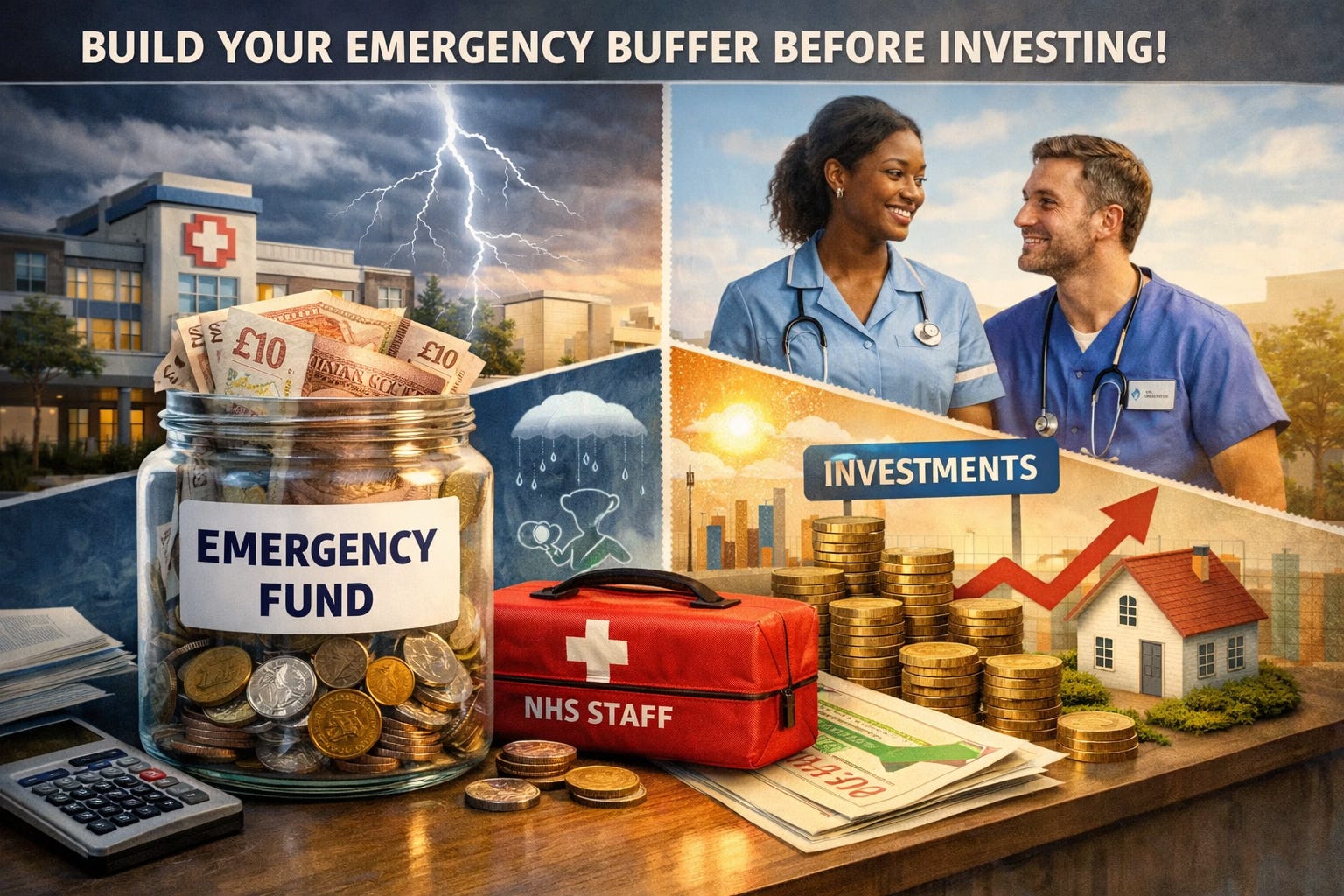
An emergency fund is not exciting. Nobody has ever gone to a party and talked about their savings account (that would be very strange), but it is one of the most important financial steps we can take before doing anything else.
What is an emergency fund?
An emergency fund is a pot of money set aside for genuinely unexpected expenses. Not holidays, or a new phone and definitely not “I’ve had a tough week and deserve something nice.” Those are fine, but they are planned spending (or should be).
An emergency fund covers things like:
The boiler breaks in January
The car needs an MOT repair we didn’t see coming
We need to take unpaid leave for a family emergency
A period of sickness that outlasts our NHS sick pay entitlement
The common thread: these are expenses we didn’t choose and can’t easily avoid.
Without a buffer, these situations often lead to credit cards, overdrafts, or selling investments at the worst possible time (hmmmmm). With a buffer, they become inconvenient rather than financially damaging. The psychological difference is significant (see further down).
Why does this come before investing?
Investing is a long-term activity; we put money in and, ideally, leave it alone for years. Markets go up, markets go down, and over time the trend has historically been upward. That patience is what generates returns.
But what happens if we need that money six months in? The market might be down 15%. We sell at a loss, not because the investment was bad, but because we had no other option.
An emergency fund protects you against this. It means our investments stay invested through the rough patches, which is exactly when they need to be left alone.
Think of it this way: the emergency fund protects the investment, not just us. Without it, we are likely to undermine the very strategy we set up, or interrupt the compounding effect (read more about that here).
If you want to understand more about why staying invested matters, we covered this in The sky is falling, your portfolio doesn’t care.
How much should we aim for?
The standard advice is three to six months of essential spending. Not income, spending. There is an important difference.
Essential spending means the basics: rent or mortgage, utilities, food, transport, insurance, and minimum debt repayments. It does not include Netflix, gym memberships, or eating out. Those are the first things we would cut if income dropped. Yes, you can live without Netflix.
For NHS staff, here is a rough sense of what that might look like:
Bands 2 to 4 (approximate take-home £1,400 to £1,800/month): Essential spending may be around £1,000 to £1,400. Three months would mean roughly £3,000 to £4,200.
Bands 5 to 6 (approximate take-home £1,900 to £2,400/month): Essential spending may be around £1,300 to £1,800. Three months would mean roughly £3,900 to £5,400.
Band 7 and above (approximate take-home £2,400+/month): Essential spending varies more widely at this level, particularly with mortgages. Three to six months is a sensible range, but the exact figure depends on commitments.
These are rough numbers, not targets. The point is to sit down, work out what we actually spend on essentials each month, and multiply by three as a starting point.
Key point: Three months is a good baseline. Six months is more comfortable, particularly for those with dependants, a mortgage, or less stable working patterns (e.g. bank-only or locum staff). There is no “correct” number, but zero is definitely wrong.
Where should we keep it?
The answer is boring on purpose: an easy-access savings account.
Not invested or locked away. Not in premium bonds where it takes days to withdraw (I won’t get started on premium bonds!). Just a straightforward savings account that we can access within a day or two.
Why not invest it? Because the whole point is that it’s there when we need it, at its full value, without waiting for a market recovery or a notice period.
Key point: Investing an emergency fund defeats its purpose.
A few things to consider when choosing where to keep it:
Easy-access savings accounts are the default option. Many pay a reasonable interest rate and allow instant or next-day withdrawals. Shop around, as rates vary quite a bit between providers.
A separate account from daily spending is important. If it sits in our current account, it will get spent. Out of sight, slightly out of mind, is the goal.
Interest rates will not beat inflation in most cases. This is fine. The emergency fund is not an investment, so think of it like insurance. We do not expect our car insurance to generate a return, and this is no different.
If you want to understand why inflation matters and what “risk-free” actually means, we covered that in What does risk-free rate mean and why does it matter?
Common objections (and why they don’t hold up)
“I can’t afford to save anything”
This is worth taking seriously, because for some people on lower bands it’s genuinely tight. But even small amounts matter. £50 a month gets us to £600 in a year. That is not three months of spending, but it covers a broken appliance or an unexpected bill. Something is better than nothing, always.
The trick is to start before it feels comfortable, not after. If we wait until we can “afford” to save, we’ll be waiting a long time.
“I’ll just use a credit card if something comes up”
Credit cards charge interest and using debt to cover emergencies creates a second problem on top of the first one. Then we’re paying off the emergency plus interest, which eats into next month’s budget, which makes the next emergency harder to handle. It compounds, just not in the direction we want.
Psychologically, it is very risky to view credit as a crutch or saviour. This kind of thinking spirals into shocking levels of debt very quickly, so please be very careful!
“My NHS sick pay will cover me”
It may, for a while. Full pay for sickness absence depends on length of service, and it does run out. After one year of NHS service, for example, the entitlement is typically one month full pay and two months half pay. After five years of service, it increases to six months full and six months half. But even half pay can be a shock to the budget if we’re used to spending based on full pay plus enhancements.
Key point: NHS sick pay is a benefit, not a guarantee. An emergency fund fills the gap between what the NHS provides and what we actually need.
“I’d rather put the money into my ISA”
Understandable, but premature. An ISA is for money we don’t need for several years. If we end up pulling it out early because we had no emergency fund, we’ve lost the benefit of long-term compounding and may have sold at a loss. Build the safety net first, then invest. The ISA will still be there once the emergency fund is in place.
For more on how ISAs and long-term investing work, see Passive investing: the calm way to build wealth and Setting up a stocks and shares ISA.
How to actually build one (practical steps)
Knowing we need an emergency fund is the easy part. Actually building one takes a bit of structure.
Work out essential monthly spending. Go through a couple of months of bank statements. Add up rent/mortgage, utilities, food, transport, and minimum debt repayments. Ignore everything else. That number, multiplied by three, is the initial target.
Set up a separate savings account. It should be easy-access, not linked to a debit card, and ideally with a different provider from our main account. The slight inconvenience of transferring money between banks is a benefit!
Small sacrifices. You will be shocked at how quickly the “small stuff” adds up. Hospital coffee, a small snack, a bought lunch might set you back anywhere between £4 to £20+ a day. They are small enough to mentally ignore, but try passing on them for 1 week and divert the money to your emergency fund. You will be surprised at how quickly it piles up. Don’t deprive yourself, but look for unconscious minor spending patterns.
Set up a standing order on payday. Even if it is £25 or £50 a month. The key is automation: if we have to remember to transfer the money, it probably won’t happen consistently. Treat it like a bill that gets paid before anything discretionary.
Top it up when possible. Got a tax refund? Night shift bonus that was larger than expected? Any irregular income is a good candidate for the emergency fund until it hits the target.
Stop when it’s full. Three to six months of essential spending is the goal, not an infinite savings pot. Once it’s built, redirect that standing order into an ISA or other investment. The emergency fund’s job is to sit there quietly and be boring.
Pay rises. If you can, immediately increase your monthly direct debit each time we get a pay award. This April (2026) we will receive a ~3.5% pay rise, though this is still poor when inflation adjusted, if you do not need the additional income to pay off high interest debt, it becomes an excellent candidate to increase your direct debit. Once emergency fund is full, you can direct it to your as well ISA.
One more thing
There’s a psychological benefit to an emergency fund that doesn’t get talked about enough. When we know we have a buffer, financial decisions become calmer. We’re less likely to panic when markets drop. We’re less likely to stay in a terrible job purely because we can’t afford a gap in pay. We’re less likely to make rushed decisions about overtime or extra shifts driven by anxiety rather than choice.
It doesn’t solve everything, and for people who work demanding jobs with unpredictable hours and a lot of emotional weight (which describes most of us in the NHS), that space is worth more than any investment return.
On-call summary
An emergency fund is a pot of cash, separate from daily spending, that covers unexpected expenses
Build it before investing: it protects both us and our investments from forced, poorly-timed decisions
Aim for three to six months of essential spending, kept in an easy-access savings account
Start small if needed: £50 a month is better than nothing, and automation makes it stick
Once it’s full, redirect contributions into long-term investments like an ISA
The real value is psychological: less anxiety, better decisions, and the freedom to let investments do their job
This article is for educational purposes only and does not constitute financial advice. For advice tailored to your personal circumstances, please consult a qualified financial adviser.